Showing posts with label Burlington Science Center. Show all posts

Wednesday, June 12, 2013

Day 141 - Burlington Science Center Staff

The Science Behind our Energy:
EnergyExhibit00
Over the past two months the Burlington Science Center’s exhibit, “The Science of Energy” has made its way through the main lobbies of all four Burlington elementary schools. An array of interactive exhibits accompanied by informational displays encouraged students to learn about the many forms of energy and how energy can change or transfer from one form of energy to another.
Students were guided through the exhibit by answering essential questions differentiated at each grade level. From the looks of our pictures below its clear everyone was engaged and excited to learn all about the energy of our world!
EnergyExhibit4
Energy comes in many forms!
EnergyExhibit5
Exploring all the different exhibits!
EnergyExhibit3
Solar energy can be used to run motors, play music, and light our homes!
EnergyExhibit1
Cranking up the Science Center’s electromagnet generator to make electricity!
EnergyExhibit2

Friday, June 7, 2013

Day 138 - Sean Musselman, Burlington Science Center

Lego League Bringing Students of All Ages Together:
robots-7
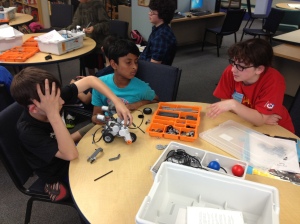
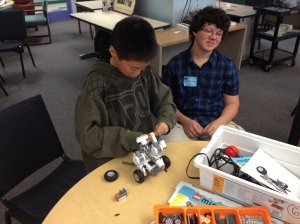
Drop by the Francis Wyman library on a Monday afternoon and you’ll witness some of the most incredible learning and mentorship taking place between Burlington students. Approximately twenty fifth graders work in groups of two and three, constructing robots of all different designs and purposes. Alongside them sit volunteers from the Burlington High School Robotics Club, providing guidance and encouragement but providing the freedom for the younger students to experiment, create and test their own unique machines.
robots-1
Marshall Simonds student, Michelle Pothier with club participants brainstorming what’s next for their robot. “The club’s main goals are to introduce kids to basics of design, problem solving, what is a robot and how do robots work” says Gerry Pothier III, an alumni of the club who sits beside Michelle Pothier, a middle school robotics team member assisting students assembling a “capture and throw” robot. “The biggest challenge for the kids is to bring a concept they have to reality and communicating with their teammates how they want to do that.”
robots-3

Constructing the robot using LEGO Mindstorms robotics kits purchased throughgrant by the BEF in 2010. Club coaches and Francis Wyman teachers, Cid D’Amico and Anne Rigby are quick to admit that their role is largely supervisory. They point to the volunteers as the real cogs that move the club forward. From their perspective they see another side to the learning taking place.
“This club is really bringing kids together, forcing them to work alongside partners… work with each other,” says D’Amico a fifth grade teacher at Francis Wyman.

robots-4
Fifth graders program their robot with guidance from BHS volunteers. The Lego Robotics club is now in its third year at Francis Wyman. It was originally started with the help of the Burlington Education Foundation, spearheaded by the Pothier family who had students in Francis Wyman at the time.

“This in itself is an incredible experience for a high school student,” says Roberta Pothier. ” One of reasons we started a program in the Francis Wyman was to show the younger students what their capabilities are now and in the future.  My daughter was in the 5th grade at the time the program started and is [now] an active participant on the high school team. We have started a program on a smaller level at the middle school this year and hope to expand that in the future.”
The Francis Wyman Robotics Club is an eight-week program that runs through the end of the school year. Keep your eyes open on this blog for final robot designs from our budding robotics engineers!
robots-9
robots-6
robots-5


Enhanced by Zemanta

Tuesday, May 21, 2013

Day 126 - Sean Musselman, Burlington Science Center

How Much Does the Gray in an Elephant Weigh? Supporting Science Practice through Children's Literature:
 One of my favorite storybooks as a child was, "Cloudy with a Chance of Meatballs." As a youngster, its imaginative storyline and humorous illustrative details kept me pouring over the pages and reaching for it again and again. Over the past several years I have spread my joy for this story as a gift at baby showers and birthday's for young readers. Besides taking pleasure in writing, "hope you grow up to be a great 'meat'eorologist!" on the inside cover, the author's soft-edged storyline highlighting the challenges humans face from extreme weather events are particularly relevant given climate projections for our next generation. Never mind the fact such hurdles for humanity come from precipitating food!

This week I found myself looking for a change-up at the local Barnes & Noble. With my former selection feeling a bit stale (nyuk-nyuk) I combed through the newer titles in search of a suitable replacement. I ultimately came across an enchanting rhyme book titled, "How Much Does the Gray in an Elephant Weigh?" by Erik Van Os, Elle Van Lieshout, Alice Hoogstad, and Mary Chris Bradley. The story follows a grandfather and his grandchild through a zoo. As they observe each animal, the grandfather openly wonders about the characteristics of each animal. Why does the giraffe have brown spots? Do the zebra's stripes go up or down? Do polar bears "beat the heat" with frozen treats? While many of the questions can be characterized as silly, the accompanying illustrations and clever rhymes will undoubtedly keep young readers interested and coming up with unusual predictions for answers!

Better still, the grandfather (and author by default) models one of the eight science practices being emphasized in the Next Generation Science Standards. Of course, "asking questions" has been at the foundation of scientific inquiry for a long time. But as science educators we are constantly looking for opportunities to model these practices and give students the chance to try them out for themselves. By reading picture books to kids that model these practices we are supporting student scientific literacy and a life-long love for reading simultaneously. Such picture books can also act as springboards to an investigation or exploration. This concept is by no means novel. The NSTA has been publishing recommendations for science and literature tie-ins for years, publishing monthly and annual recommendations.

There are plenty of titles available for kids that support science (the Ms. Frizzle series stands out in my mind as an obvious choice.) But I often find myself identifying books for the exposure to science content they provide. As our standards focus more on the practice of science I'll have to keep a keener eye out for books that include characters who are curious and exploratory, observe carefully (Encyclopedia Brown?), collect data and put their predictions to the test! If you have any already in your early reader repertoire please share in the comments below!

Tuesday, February 12, 2013

Day 78 - Sean Mussleman, Burlington Science Center

How Much Liquid Water in a Foot of Snow?:

This past weekend’s blizzard covered New England with several inches of snow and will be remembered as one of the largest (and longest!) storms to coat Burlington in memorable history.
The snow could not have hit at a better time for our elementary schools though, as many of Burlington’s fourth graders are either wrapping up or just starting their science units on weather and climate!

A question often asked by students (and adults) is how much liquid water is there in a foot of snow? When learning about matter, students learn how matter contracts as it gets colder taking up less space, and expands as it gets warmer (taking up more space!)

But water is not like most matter. Thanks to water molecules electronegativity its molecules organize themselves into a special six-sided arrangement that produces a perceived hollow crystal interior. When ice and other forms of solid water are heated up, the arrangement breaks down, the hollow space collapses and the water “melts” into its liquid form. As you can see in the diagram below, liquid water ends up taking up less space than solid water and is therefore more dense than ice!
Water Molecular Arrangement
This phenomena has a profound effect on our Earth! Since ice floats the tops of Earth’s bodies of water freeze over while marine creatures live below. If ice was more dense (like most matter) ice would sink to the bottom, crushing marine creatures below and leaving our seas and rivers relatively lifeless!

Consider trying this experiment with your students or children and see if you get the same results! We are familiar with many different “kinds” of snow (light and fluffy, wet and sticky to name a few!) Do all of these snow types melt into the same amount of water? Does location matter? Allow your students and kids to explore the possibilities and maybe devise their own experiments!


Enhanced by Zemanta

Wednesday, January 30, 2013

Day 70, Burlington Science Center

Our Feature Exhibit called “The Science of Bears”:
Every other year, the Science Center designs, develops and builds an exhibit that travels to each lobby of the elementary schools in Burlington.  These exhibits are smaller, home-made versions of exhibits you would see at a science museum.  The exhibits have a main theme and covers a variety of science curriculum topics to explore.  Teachers can bring their classes down during the school day and students can visit the exhibit on their way to lunch or while walking through the hallway.
photo-5
This years current exhibit is called “The Science of Bears.”  We received a private donation of  taxidermy bears several years ago and decided it was a once-in-a-lifetime experience to have these bears travel to the schools.  The exhibit focuses on the natural science of bears and includes such topics as life cycles, characteristics/traits and adaptations.
photo-19photo-18
photo-15
photo-16
photo-11
photo-9
photo-21
photo-14
photo-17
photo-10
photo-12
photo-13
photo-6
Here are some students enjoying the exhibit.
photo-27
photo-22
photo-25
photo-28
photo-23
photo-29
photo-26
Special thanks to Dennis, Diane, Steve, Matt and custodial staff for helping move the exhibit.
photo-4
photo-8


Enhanced by Zemanta

Friday, January 11, 2013

Day 58 - Lauren Kippenberger, Memorial School Grade 3

Exploring Sound

Today Mr. Musselman came by! Here are a few pictures of the Sound presentation he did for the students!


Reviewing some vocabulary about Sound

The Boom Whacker Band (instruments that demonstrate pitch, which the
students use their heads to produce the sound!)

Mr. Musselman conducting the band


Discussing why the tubes are different lengths 


Demonstrating sound waves

Using a slide whistle

The homemade flute!